The Intelligence Part Of Artificial Intelligence
What is the "intelligence" AI aims to build? Taking inspiration from the mechanization of computing (formerly a human occupation) and from the inclusive spectrum of animal cognition, I argue there has always existed an honest, useful, and humble definition of intelligence that reveals itself as soon as we discard our unscientific sense of human exceptionalism. This is what AI should seek to mechanize.
Artificial What?
We hear constant talk of artificial general intelligence and artificial superintelligence, despite a profound lack of clarity as to what “intelligence” parts actually means. As a result, AI discourse often sounds more like marketing copy shilling “enterprise super-duper-intelligence” than discussion of a scientific agenda. To put discussion of AI on firmer intellectual footing, I seek a practical understanding of intelligence not by reaching for new concepts, but by examining familiar examples from the history of computation and the science of animal cognition. These examples push us past the myopic perspective of human exceptionalism, showing that computation has long occupied the realm of intellectual labor and that human intelligence is just one specific instance of many intelligences evolved through natural selection.
Let us begin by placing today’s questions about intelligent machines within the broader history of computation.
The Intelligence Of Human Computers
To humans alive in the 2020s, the word “computer” refers to a machine. In particular, we understand computers to be a type of machine that is electronic and digital in nature, typically assembled from integrated circuitry that we print directly onto wafers of silicon.
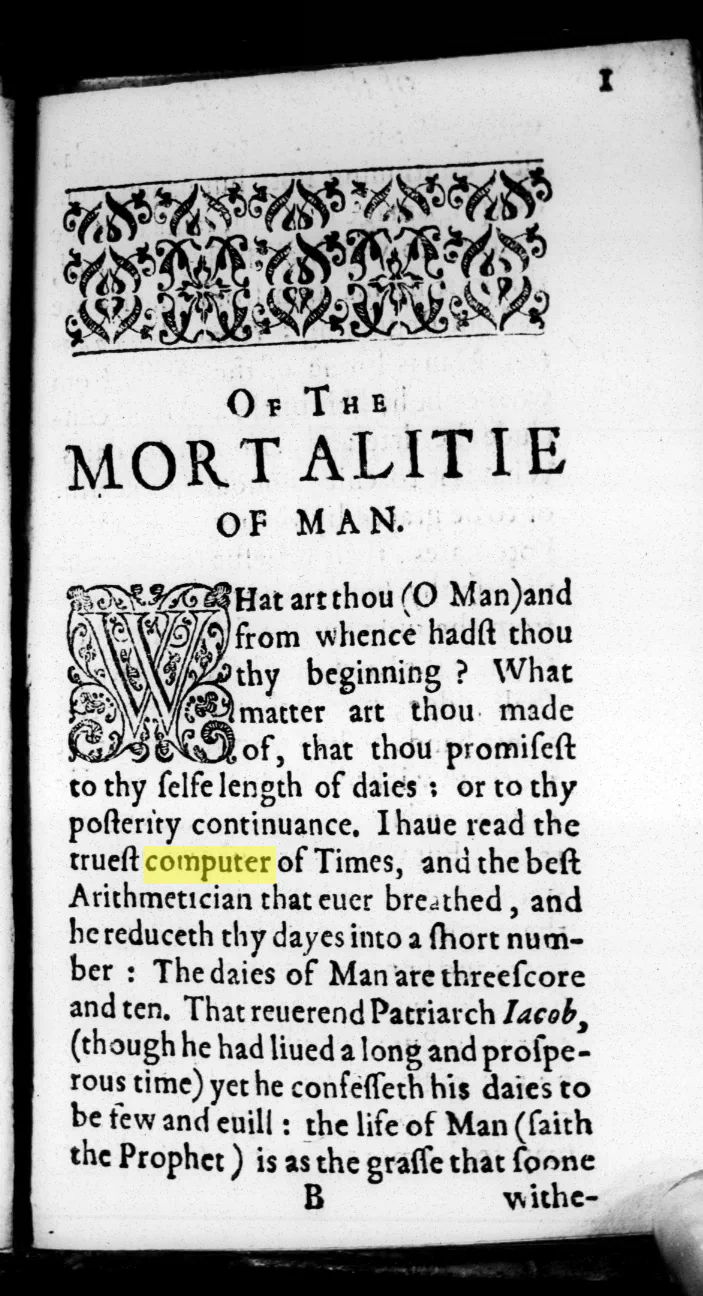
In contrast, to the humans of the 1920s, this modern definition would have elicited great confusion. To this cohort, computers did exist (the concept had been around for over 300 years at this pointSee the Computer_(occupation) Wikipedia page or the original source of the figure above.), but it referred to people, not machines. Indeed, to compute was the labor of knowledge workers who carried out mathematical operations in service of scientific or engineering endeavors.
In the 1600s, computers aided astronomers in calculating the positions of planets. By the 1700s, governments had begun employing teams of computers for applications of national importance, such as deriving tables to aid maritime navigation. In the 1800s, computing grew in scale and standardization, with large teams of women hired to divide up batches of calculations in an early form of parallel processing.

One such team of computers, the Harvard Computers, included some of the foremost women astronomers of the nineteenth century. One of these computers, Henrietta Swan Leavitt, produced the eponymous Leavitt’s Law, a breakthrough enabling measurements of vastly larger astronomical distances than had been tenable previously.
Today, decades after automating computation, we tend to overlook its brilliance, treating it as a rote mechanical process akin to the turning of a waterwheel. Ironically, however, this human exceptionalism undermines the intellectual exceptionalism of humans like Leavitt, herself a career computer. Imagine if we instead appreciated the intelligence of computation the way we appreciate the physical demands of manual labor. We acknowledge that plowing a field is demanding whether done by a human, ox, or tractor, and when we watch a gigantic combine tractor churn a cloud of dust as it harvests a sprawling field, we are more likely to marvel at its power than to dismiss the task it performs. What if we thought of computing the same way?
Making chips small and cheap need not diminish the power of executing a billion error-free operations in a second. Although machines now perform these operations faster and better than humans, but we can still consider them intelligent today for the same reasons we considered them so for hundreds of years before.
If you’re ready to continue exploring intelligence that has been embodied outside the human mind since before the advent of the field of AI, let us turn our attention elsewhere, to the full spectrum of biological intelligence.
Animal Cognition Illustrates The Spectrum Of Intelligence
In his book Are We Smart Enough to Know How Smart Animals Are?, behavioral biologist and ethologist Frans de Waal lays out the extensive history of psychologists underselling the intelligence of nonhuman animals. “For most of the last century,” de Waal writes, “science was overly cautious and skeptical about the intelligence of animals… Students of animal behavior either didn’t care about cognition or actively opposed the whole notion.”
This excessive skepticism arose partly as an overcorrection to earlier misinterpretations of animal behavior. The most famous case was Clever Hans, a horse purportedly capable of arithmetic who was in fact responding to subtle, involuntary cues from his human questioners. The trend went far overboard, however, into scientifically unverifiable (but, as later work showed, scientifically disprovable) claims of humans being the only animals to possess certain mental faculties.
Today the fields of science studying animal cognition have arrived at an altogether more enlightened understanding of just how smart animals are, human and nonhuman alike. In De Waal’s terms, “I look at human cognition as a variety of animal cognition. It is not even clear how special ours is relative to a cognition distributed over eight independently moving arms, each with its own neural supply, or one that enables a flying organism to catch mobile prey by picking up the echoes of its own shrieks.”
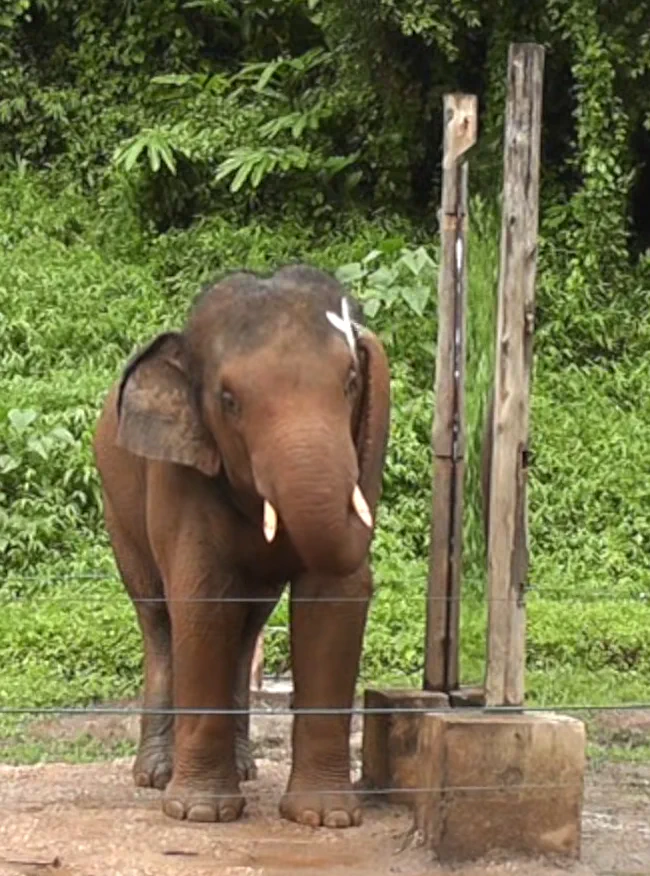
Are We Smart Enough to Know How Smart Animals Are? is rich with vivid examples like these. In one case, de Waal tells the story of how his collaborators used elephant-sized 8’x8’ mirrors to conduct the mirror test on a cast of captive pachyderms. In the end, Asian elephant Happy passed the test, contrasting with previously published negative results (which had used woefully too-small mirrors) and demonstrating that elephant intelligence encompasses some capacity for self-recognition.
The science of animal intelligence has taught us a lot about intelligence in general over the past century because it has contextualized human intelligence as a special case on the overall spectrum of intelligence. As a species, we have graduated from an emotionally motivated anthropocentric view of intelligence to an empirically grounded and holistic view. We seek both to understand what sets the human mind apart from the minds of other species as well as to understand the qualities we share with other species, such as planning, empathy, and capacity for sophisticated tool use.
The study of animal cognition even provides a clear meaning for the terms “cognition” and “intelligence”. As de Waal puts it, “Cognition is the mental transformation of sensory input into knowledge about the environment and the flexible application of this knowledge. While the term cognition refers to the process of doing this, intelligence refers more to the ability to do it successfully.”
Unlike many species of sharks, humans have no electroreceptors, and our eyes have only three types of cone cell, rather than the four possessed by many birds, fish, and reptiles, affording us the ability to at most develop trichromatic color vision rather than tetrachromatic. Our intelligence, which evolved alongside this limited palette of sensory input, can not be fairly considered general across a wider spectrum of color or eletromagnetic sensory input. We are not truly generally intelligent, we are specially intelligent in the niche we have evolved to fill, just as is the rest of the animal kingdom. All intelligence is specialized to certain applications.
Returning To “Artificial Intelligence”
The history of computers and the science of evolutionary cognition replace the idea of intelligence as some special human spark with new and broadened perspectives. At this juncture, one may wonder whether the progenitors of AI had such an inclusive idea in mind when they chose the term “intelligence” as half of the name, or if they had intended something more anthropocentric. The answer to this question begins with the intentional vagueness of the term “artificial intellligence.”
In the mid 1950s, John McCarthy coined the term “artificial intelligence” as a neutral label to accommodate several competing research agendas under a single summer conference.The Wikipedia page covering the 1956 Dartmouth Workshop is a fascinating look back in time.
Contrast this with the then-popular field of cybernetics, whose founders named it with a neologism at inception afforded it a crisp definition. AI, serving as neutral intellectual ground, had to remain intentionally vague to straddle a broad span of ideas. The term ultimately succeeded in bringing together the analogue methods of cybeneticists, the probabilistically approach of information theorists, and the logic of automata theory on even footing. The price for this inclusivity, however, was giving the nascent field a distinctly “in the eye of the beholder” flair.
This is not to say the original proposal for AI was lacking in concrete detail. McCarthy and collaborators put forth a bold conjecture “that every aspect of learning or any other feature of intelligence can in principle be so precisely described that a machine can be made to simulate it.” They also specifically called for an attempt “to find how to make machines use language, form abstractions and concepts, solve kinds of problems now reserved for humans, and improve themselves.“The full document is short and clearly written, so consider reading it in full. Ray Solmonoff’s website hosts a lovely copy: the original proposal for the 1956 Dartmouth Summer Research Project On Artificial Intelligence [PDF].
What should we make of our original question, then, of whether the founders had an open or closed notion of intelligence? Well, on the one hand they were taking an intentionally inclusive stance to unite many different ways of thinking about AI as a research agenda. On the other hand, they did explicitly focus on “problems reserved for humans”, which at the time already dismissed the intelligence of computation.
The Tyrannny Of “Whatever The Machines Haven’t Done Yet”
Many of the “kinds of problems now reserved for humans” in 1955 have become the kinds of problems which are frequently performed by computers today. In addition to newfangled technologies like machine translation and automatic speech recognition, many more established tools fall into this category as well. For instance, even the humble symbolic integration capability that comes baked into a TI-89 Titanium calculator was an AI breakthrough when it was invented in the 1960s.The SAINT system for symbolic integration published in James Robert Slagle’s PhD dissertation [PDF] is arguably the first expert system ever devised, pioneering this subfield of AI.
Despite dramatic progress in computing, it appears we have collectively and continually reapplied the “reserved for humans” criterion to keep the modern measure of intelligence perpetually one step ahead of mechanization. Tesler’s Theorem, a tongue-in-cheek definition of AI coined by Larry Tesler around 1970, states that “Artificial Intelligence is whatever machines haven’t done yet.” Tesler’s framing makes the tautology comically clear: If we ever fulfill MacCarthy’s vision of making a machine simulate human intelligence, the breadth of human intelligence would sooner contract into nothingness than be sullied by the unpleasantness of computation.
[TODO: Transition. AI DRAFT: “If intelligence is “whatever machines haven’t done yet”, then every time a machine succeeds, the goal moves. That’s not a useful target. A better approach is to ask what remains valuable across the examples we’ve already seen. From human computers to animals. In each case, what matters isn’t whether it’s exclusively human, but whether it does something useful.”]
Synthesis: Useful Behavior As A Useful Definition Of Intelligence
What do we get when we combine the view that computers are already inherently capable of intelligent behavior with the admission that the human role model of intelligence is but one point on a spectrum? A lot, in the context of better understanding the point of the field called Artificial Intelligence.
TODO: Pull in these quotes from de Waal
“Every species deals flexibly with the environment and develops solutions to the problems it poses. Each one does it differently. We had better use the plural to refer to their capacities, therefore, and speak of intelligences and cognitions.”
If you find yourself still skeptical, consider a few more of De Waal’s examples, such as the fact that “We don’t need echolocation to orient ourselves in the dark; nor do we need to correct for the refraction of light between air and water as archerfish do while shooting droplets at insects above the surface.” It is due to cases like these, clearly observable to the curious eye, that he can confidently conclude “There are lots of wonderful cognitive adaptations out there that we don’t have or need. This is why ranking cognition on a single dimension is a pointless exercise. Cognitive evolution is marked by many peaks of specialization. The ecology of each species is key.”
An Inclusive Definition
First, we are liberated to take an inclusive view. When we accept the historically-informed view that even execution of simple arithmetic rules engines represents intelligent behavior, we are able to stop asking “are we there yet?” and instead ask the more helpful question of “how can we go further?” If ants are on the same spectrum of intelligence as humans, but dogs make for better service animals, how can we artificially create something more like a dog’s intelligence than an ants?
[TODO: expand and adjust away from the “first… second” phrasing]
A Scientific View
Second, we are pushed to take a more evidence-based approach to intelligence. Intelligence is not a useful concept if it is allowed to be too broad, and so if we do not constrain it arbitrarily to being “that special human thing” then we must take an empirical tact. With animals, we understand that the principle of natural selection gave rise to intelligence as a capacity for survival. Intelligence is thus in its most core form useful behavior. Though Just as the intelligence of the Harvard Computers was demonstrated through the useful act of mapping out stars and galaxies, intelligence
[TODO: expand and adjust away from the “first… second” phrasing]
So usefulness is something that you know. Clearly computation is useful because we’re spending billions and billions of dollars on computer chips to do computation. Intelligence is useful for many types of animals and many types of ways because natural selection has allowed intelligent creatures to survive while outcompeting other creatures which did not demonstrate the same level of useful behavior. So, we should then stop thinking about intelligence as exactly what it looks like or if it’s a special thing spark or what is spark. Instead, we should characterize it through the behavior it enables.
In Closing
[TODO: tie together the themes of motivation (goal for AI), history of computers (human shortsightedness / short memory), and broader spectrum of animal intelligence. Recap how there is still some element of “I know it when I see it”, but that the “I know it” is much more clearly tied to doing useful things, e.g. which advance our understandings of the universe, which keep you alive through natural selection, etc.]
WIP snippets and TODOs
TODOs:
- [develop better and tie in as a response to the notion that human intelligence is special because we have a mind / consciousness]
- tie in the founding inclusivity of AI with the notion that AI should adapt and include a more modern view of intelligence as a spectrum (but also drop the moving goalposts of computation losing its status as cognition)
[the below is snipped for the conclusion] She was a college-educated scientist who took one of the best jobs available to her at the time, that of being a computer.
[the below is snipped for the conclusion] While a narrow anthropocentric view still places intelligence as the special human spark tied up in activities like building civilizations, doing science, or reading and writing, humans today understand intelligence much better than that. Biologists give compelling evidence of intelligence as a spectrum of useful behavior, a spectrum on which human intelligence is just a single, albeit meaningful, point.
[more random cuts below] This clarity was hard won by decades of oft-dismissed study into the varied brilliance of many nonhuman species from mammals like primates and elephants to corvids (family of birds that includes crows) and even honeybees and wasps.
Though it is common to use comparative phrases like “more intelligent” that place intelligence on a single dimension, the science of animal cognition has delivered compelling evidence of a more fractal, many-faceted pattern. De Waal writes: